The ideas
Why some transformations stick
Canterbury’s transformation was not a series of projects but an interconnected system of enablers, each strengthening the others. Strengthening one boosted the rest.
Chapter 14
The 12 enablers of large-scale system transformation
Developing a shared vision
Building a social movement
Redefining the role of the funder
Connecting the digital platform
Using data to plan, design, improve and transform
Implementing HealthPathways
Understanding people and leading in crisis
Aligning the environment, including the built form
Strategically aligned training and development
Leadership and governance alignment
Collective impact: releasing the power of collaboration
A way of planning that supports implementation
The test
Every enabler answered to Agnes
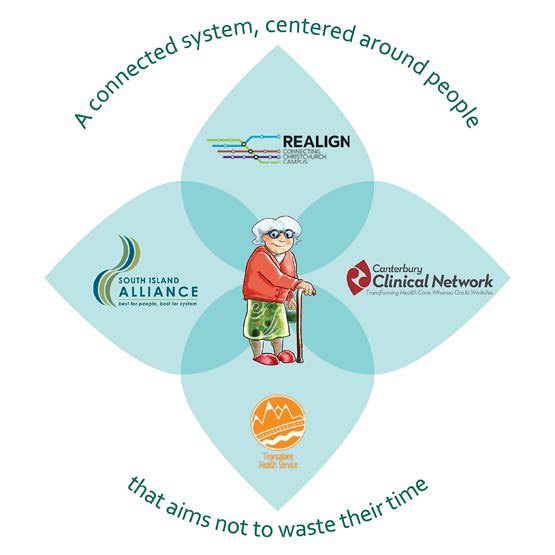
Canterbury’s working test for any change was not whether it satisfied a contract or a target, but whether it made sense from where Agnes was standing. Would it save her a trip? Would she have to repeat her story? Would anyone notice if it failed?
Drawing the architecture this way - alliances, networks and programmes arranged around a single person rather than around each other - kept the enablers honest. It is also why the same diagram appears in governance papers and on ward walls.
Why these enablers matter
A shared vision and social movement gave transformation meaning. Relationship-based design and aligned leadership gave it trust. Digital and data infrastructure gave it transparency. Capability-building and adaptive planning gave it durability.
Seen as a single architectural blueprint, these enablers reveal why Canterbury’s results persisted long after the headlines faded. They made improvement the standard rather than the exception - transforming values into habits, and strategy into muscle memory.
Eight principles of lasting change
What the authors would tell anyone starting out
Start with what matters most
Begin with the outcomes that matter to people, not with a list of interventions.
Design for relationships
Relationships are the invisible infrastructure that holds a system together under pressure.
Follow the natural patterns
Work with how care actually flows, rather than against the grain of the system.
Build capability, not just solutions
Solutions expire. Capability compounds.
Create space for emergence
Many of the changes that endured were never designed in advance.
Focus on transitions
The handovers between services are where systems most often fail people.
Implement with scale
Canterbury avoided piloting, preferring system-wide models adjusted in the light of experience.
Measure what matters
Contribution, not attribution - measurement that changes behaviour rather than proving a point.
From the epilogue
The Canterbury experience does not offer a template for replication. It provides a philosophy of adaptation.
“Across the world, systems now face pressures strikingly similar to those Canterbury confronted: rising demand, workforce exhaustion, widening inequities, fragmented structures and finite resources. The familiar response is to adopt new strategies or structures or tighter controls. But Canterbury demonstrated that enduring progress begins elsewhere.
It begins with clarity of purpose. It is sustained through relationships, the often invisible infrastructure that holds systems together when everything else is shaken. And it lasts through trust and capability.
Transformation, however, is fragile. Systems that once welcomed new thinking can grow uneasy with the uncertainty it brings. Over time, the desire for predictability can harden into control. That is why leadership matters. It is leadership that creates environments where curiosity is safer than compliance.”
Reach and recognition
Where the Canterbury approach travelled
- The World Bank, The King’s Fund and the Commonwealth Fund each highlighted Canterbury as a model of integrated, people-centred care delivered without structural mergers or extra funding.
- HealthPathways is used in Wales, Australia and Ontario, and across New Zealand.
- The Acute Demand Management Service informed the UK’s Virtual Ward approach and New Zealand’s Primary Options for Acute Care model.
- Canterbury’s data and analytics approach has been adopted across several Welsh health boards and South-East England, supporting a population of more than nine million.
- Ireland used Canterbury as a model for its approach to outcomes measurement in integrated care.
- In 2015 Canterbury became the first organisation to win four Institute of Public Administration New Zealand awards in a single year, including the Prime Minister’s Award for Public Sector Excellence.